AI layoffs: what the data actually shows
Diego Mols

What you can expect in this article
- Why AI led all stated reasons for US job cuts in March and April 2026, and what that ranking hides
- Four data checks the headlines skip: the 4.5% attribution share, the shrinking denominator, the measured economy, and the missing returns
- Evidence that budgets, not work, are what is actually moving toward AI
- What the restructuring wave means for a small business: when to act and when to wait
- Three free checks to run before spending anything on AI
- Where Belgian and EU small businesses actually stand on AI adoption
AI layoffs are real, and they are also not what the headlines suggest. In April 2026, artificial intelligence led all stated reasons for US job cuts for the second month in a row1.
Companies name it in regulatory filings. Yet when researchers test whether AI is actually doing the work those announcements imply, the link gets weak.
AI was cited in 4.5% of US job losses in 20252. Total cuts in 2026 are running at half of last year's pace1.
And the organizations cutting the most report no better returns from AI than those cutting the least6.
If you run a small business and the news cycle is pressuring you to react, the data says: slow down. Here is what it actually shows.
The headlines are real
Start with what is true. The restructuring wave in AI's name is documented at three levels.
Employers say they plan it. In the World Economic Forum's survey of over 1,000 global employers, 41% said they plan to reduce their workforce as AI automates certain tasks.
The same survey projects 170 million new roles and 92 million displaced by 2030, a net increase of 78 million jobs, and 77% of those employers plan upskilling programs3.
Both things are stated at once: reduction where AI automates, growth elsewhere.
The announcements are counted. Challenger, Gray and Christmas, the firm that tracks US layoff announcements, recorded AI as the leading stated reason for job cuts in March and April 2026. April alone: 21,490 cuts citing AI, 26% of the month's total.
Year to date, AI accounts for roughly 16% of announced cut plans, up from 13% a month earlier1.
And companies put names on it. Oracle disclosed in an SEC filing that its workforce fell by 21,000 people, 13%, over twelve months, stating that the adoption and deployment of AI technologies across its operations "have resulted, and may continue to result, in reductions to our workforce"4.
Microsoft cut about 4,800 roles in July 2026 while saying those roles are "not being replaced by AI", but acknowledging AI is changing how work gets done4.
A running industry tally counts roughly 120,000 tech roles cut in 2026 by early July4.
So the AI restructuring story is not invented. The question that matters for your business is different: is AI the cause, or the caption?
The attribution test: four checks the headlines skip
Four independent lines of evidence test the link between the announcements and reality. All four point the same way.
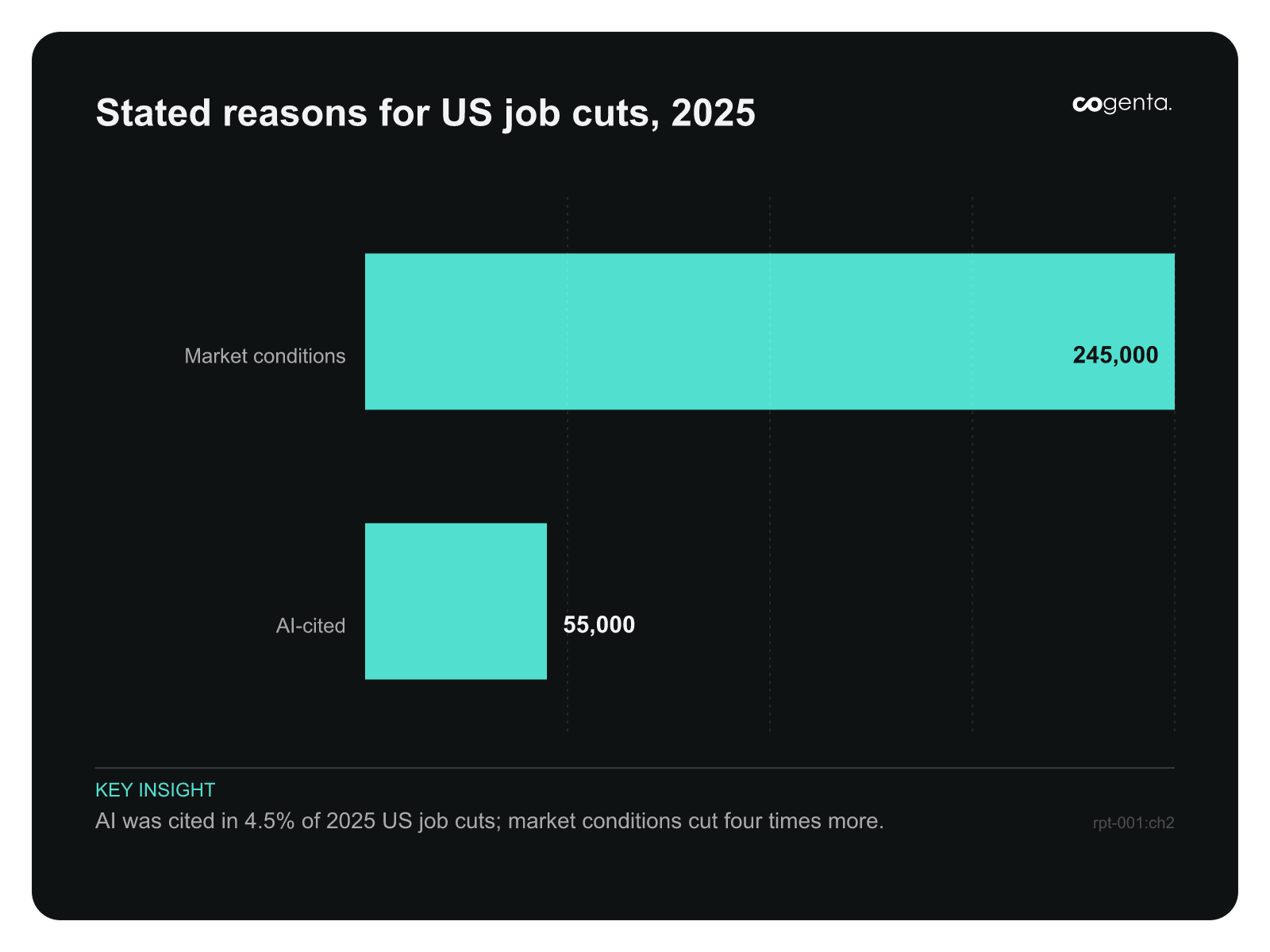
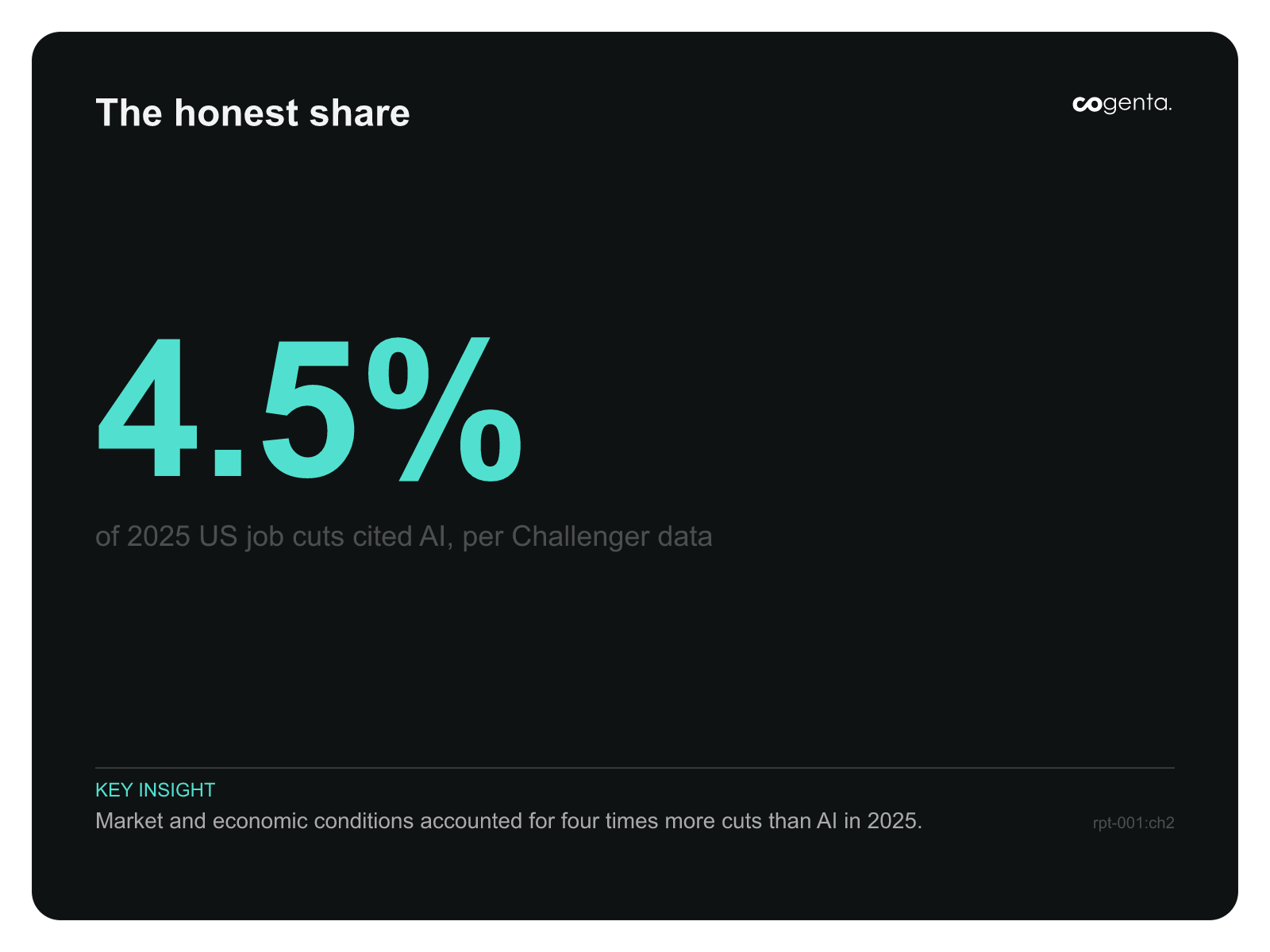
Check 1: the share. Oxford Economics, working from the Challenger data, found AI was cited in roughly 55,000 US job cuts in the first eleven months of 2025. That is 4.5% of total reported job losses.
Cuts attributed to ordinary market and economic conditions were four times larger, at 245,000. For scale: 1.5 to 1.8 million Americans lose a job in any given month, for every kind of reason2.
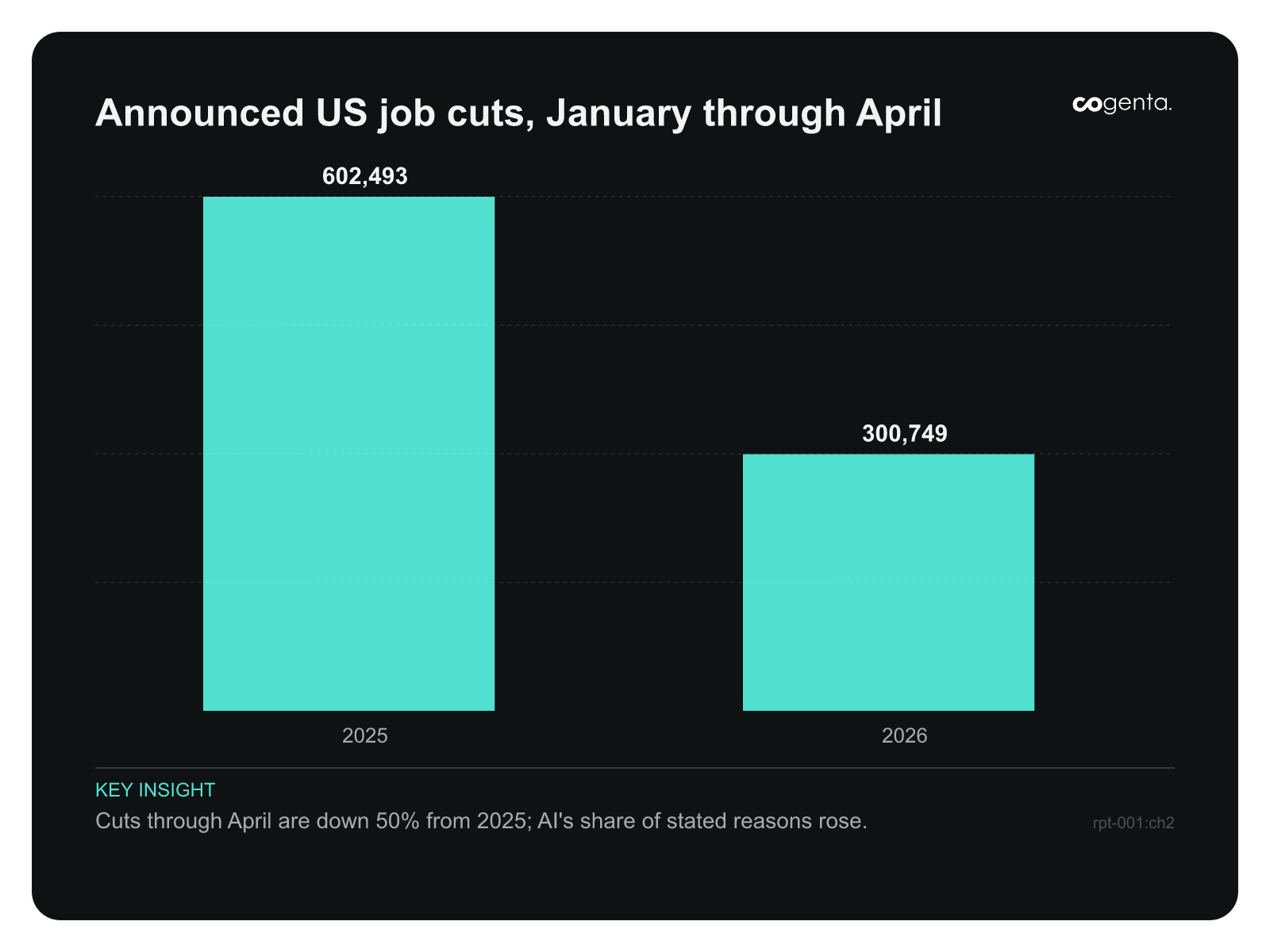
Check 2: the denominator. Total announced cuts through April 2026 came to 300,749. Through April 2025, the figure was 602,493.
The total is down 50% while AI's share of stated reasons rises1.
"AI layoffs are surging" and "layoffs are falling" are both true this year. Only one of them makes a headline.
Check 3: the measured economy. The Budget Lab at Yale compared employment and wages in AI-exposed occupations against statistically comparable unexposed ones, using the microdata behind the monthly US jobs reports.
As of early 2026: no statistically distinguishable effect on either employment or wages, and no unusual rise in workers changing occupations, which is the pattern large-scale displacement would eventually produce.
The labor market's softness traces to low hiring, not to elevated layoffs5.
Oxford Economics applies a blunter test: if AI were replacing labor at scale, productivity growth should be accelerating. It is not2.
Check 4: the returns. Gartner surveyed 350 executives at organizations deploying autonomous capabilities. About 80% reported workforce reductions.
But reduction rates were nearly identical between organizations reporting high returns on AI and those reporting modest or negative outcomes.
Gartner's own conclusion: "Workforce reductions may create budget room, but they do not create return"6.
The companies claiming AI-driven efficiency through cuts are, on average, not the companies getting AI results.
What is actually moving: budgets, not work
The most economical explanation of the gap comes from the firm that counts the layoffs. "Regardless of whether individual jobs are being replaced by AI, the money for those roles is," says Andy Challenger of Challenger, Gray and Christmas1.
Money is moving toward AI faster than AI is absorbing work. A layoff announcement that names AI serves that reallocation story, whatever the technology is or is not doing yet.
Inside companies, expectations are far more divided than the headlines. In McKinsey's global survey, 32% of respondents expect their organization's workforce to shrink in the coming year, 43% expect no change, and 13% expect growth7.
That is not a consensus about AI replacing people. It is a coin flip with a narrative attached.
None of this means AI does nothing. The same evidence base shows real, measured productivity gains from AI assistance in controlled experiments.
It means the specific claim carried by the restructuring headlines, that AI is already doing the work of the people being cut, is mostly ahead of the evidence2,5,6.
What this means for your business
You are not an enterprise. You do not have an org chart to demolish or an investor narrative to feed.
That changes what this data means for you.
Do not restructure off headlines. The companies making the loudest AI-attribution claims show no better AI returns than the quiet ones6.
If the pressure to "do something with AI" is coming from what you read rather than from a problem you can name, that is the signal to pause, not to spend.
When you do evaluate AI, check the failure record first. Research on why AI projects fail keeps finding the same causes, and none of them is model quality.
The most common is that nobody agreed what problem the project was solving. The next: chasing the technology for its own sake, and skipping the data and workflow groundwork underneath8.
In 2025, 42% of companies abandoned most of their AI initiatives before production, and the average organization scrapped 46% of its AI proofs of concept9.
Those failures are organizational and they are diagnosable in advance, for free: agree the problem, check your data exists, and decide where the tool joins your actual workflow.
The pattern we see with small businesses is that these three checks, done honestly, filter out most bad AI spending before it happens.
And remember what the tools sit on. AI applied to a connected system amplifies it. AI bolted onto disconnected tools amplifies the disconnection.
If your customer data lives in five places, no model fixes that; we have written about how AI is showing up inside CRM platforms and the same logic applies to every tool in your stack: the system decides what the intelligence is worth.
The honest summary of the 2026 data: AI layoffs are a real announcement pattern, a weak economic pattern, and a poor reason to change how you run your business. The evidence that should move you is the quiet kind: measured gains where AI joins a working system, and measured failure where it does not.
If you want a second pair of eyes on where AI would actually pay off in your business, book a free discovery call. We will tell you honestly, including when the answer is "not yet".
FAQ
Are AI layoffs really about AI?
Partly, and less than the headlines imply. AI led stated reasons for US job cuts in March and April 20261, but AI-cited cuts were 4.5% of 2025 US job losses2, econometric analysis finds no measurable AI effect on employment or wages in exposed occupations yet5, and cutting companies show no better AI returns than non-cutting ones6.
A significant share of the narrative is budget reallocation, not automation.
Should I restructure my team because enterprises are doing it with AI?
Not on headlines alone. The evidence says the announcements outrun the automation2,5, and the organizations cutting deepest report no better returns6.
If a specific, nameable problem in your business would be solved by reorganizing around a tool, evaluate that problem. If the trigger is news pressure, wait for evidence.
How many small businesses use AI?
Across the OECD, 11.9% of small firms use AI, versus 40% of large firms11. In the EU, 20.0% of enterprises with 10 or more employees used AI in 2025, up from 13.5% in 202410.
Belgium runs well above the EU average at 34.5% of enterprises12. Belgian small businesses sit in a market that adopts faster than most of Europe; we looked at that context in Belgium's SMB technology paradox.
How can AI help small businesses?
The measured gains concentrate where AI removes busywork inside a working process: drafting, follow-ups, data entry, routing. Surveys show most organizations now use AI somewhere, but only 39% report bottom-line impact at the company level, and the differentiator among those that do is redesigning the workflow rather than adding a tool7.
Applied and concrete beats broad and hyped.
What should I check before spending anything on AI?
Three things, in order. First, the problem: can everyone involved state what the AI is supposed to fix, in one sentence? Misalignment on purpose is the most common cause of AI project failure8.
Second, the data: does the information the tool needs exist, in one reachable place? Third, the workflow: where exactly does the tool join the way work already happens?
Projects that skip these checks are the ones filling the abandonment statistics8,9.
Sources
- Challenger Report, April 2026, Challenger, Gray and Christmas, 2026-05-07.
- AI layoffs and the productivity data, coverage of Oxford Economics, Fortune, 2026-01-07.
- Future of Jobs Report 2025, World Economic Forum, 2025-01-07.
- Every major tech layoff in 2026 that has name-checked AI, TechCrunch, 2026-07-06.
- AI Is Probably Not (Yet) the Reason for Labor Market Weakening, The Budget Lab at Yale, April 2026.
- Autonomous Business and AI Layoffs May Create Budget Room, but Do Not Deliver Returns, Gartner, 2026-05-05.
- The State of AI global survey, McKinsey and Company, November 2025.
- The Root Causes of Failure for Artificial Intelligence Projects, RAND Corporation, August 2024.
- Generative AI shows rapid growth but yields mixed results, S&P Global Market Intelligence, October 2025.
- 20% of EU enterprises use AI technologies, Eurostat, 2025-12-11.
- AI adoption by small and medium-sized enterprises, OECD, December 2025.
- Artificial intelligence is gaining ground in Belgian enterprises, Statbel, 2025-12-02.
Read more

AI visibility: do you exist when buyers ask AI?
Buyers increasingly ask AI assistants to find vendors. The honest numbers on how big the shift is, and a free 15-question audit to see if you show up.
Jul 8
How artificial intelligence is transforming CRM
From data clean-up to predictive lead scoring: how AI-powered CRM helps SMEs save hours, close more deals, and personalize at scale without a data team.
Mar 4
Why CRM projects fail small businesses
The famous CRM failure rates trace to marketing, not measurement. Here is what the evidence actually says about why CRM fails and what makes it stick.
Aug 9