AI visibility: do you exist when buyers ask AI?
Diego Mols

What you can expect in this article
- How many buyers actually ask AI assistants during vendor research, in the EU and the US
- The counterweight numbers: Google still dominates and AI summaries halve clicks to websites
- What decides whether an AI answer mentions your business, per the only controlled study
- A free 15-question audit to measure your AI visibility monthly, in English and in French
- The realistic visibility baseline for a small firm, and why a low score is a starting line, not a verdict
- Where Belgian SMBs stand, and why the current gap is a window
Somewhere this week, a business owner asked an AI assistant who could fix their CRM chaos, and got a short list of names. Either you were in that answer or you were not, and nothing in your analytics will ever tell you which.
AI visibility is the share of relevant AI answers that mention your business, and it is becoming a real, measurable input to how buyers discover vendors. It is also smaller than the GEO industry wants you to believe.
This piece lays out the honest numbers on both sides, what the evidence says actually drives being mentioned, and a free 15-question audit you can run monthly to know where you stand before spending a euro on the problem.
Buyers are starting to ask AI
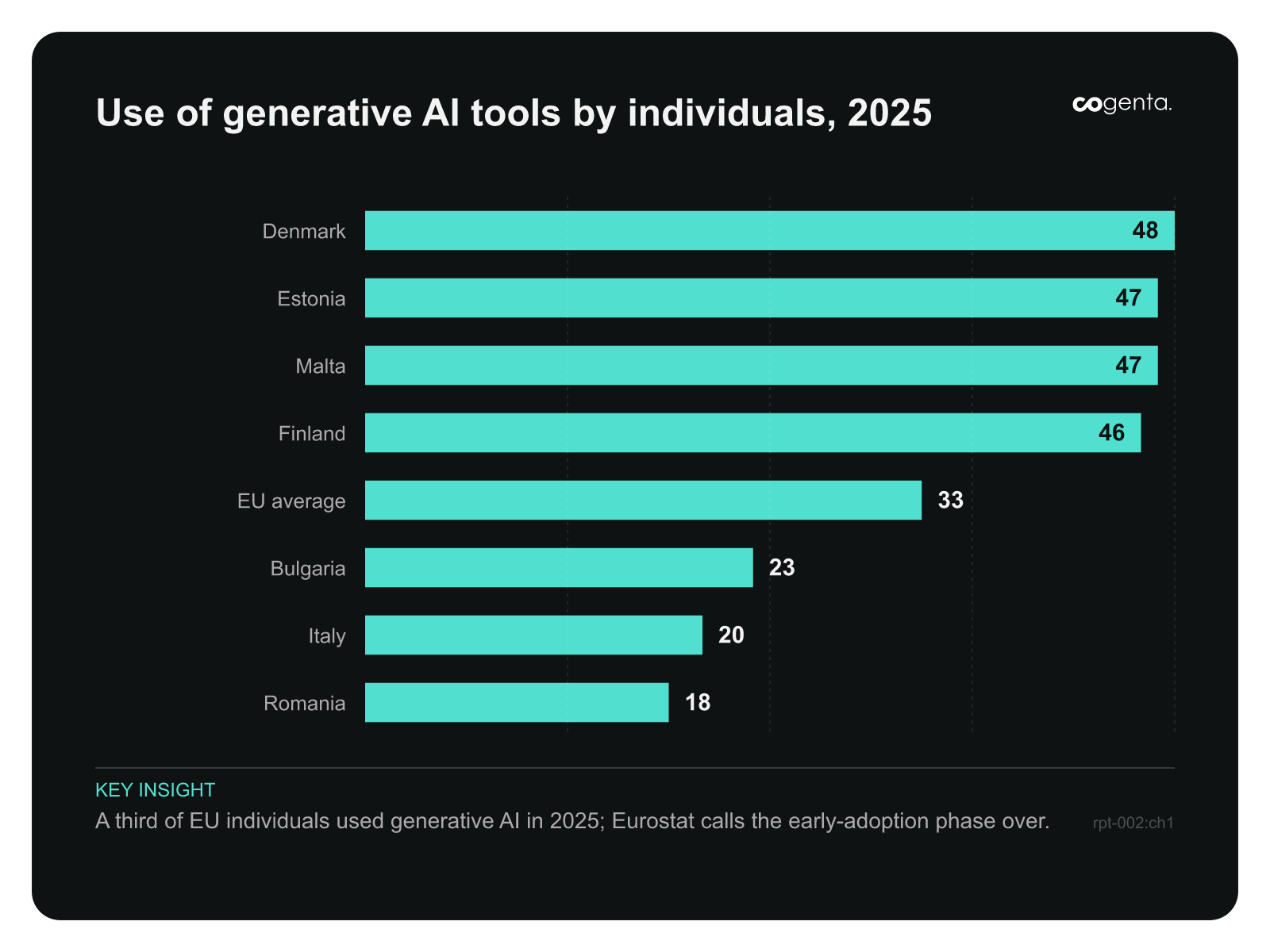
The behavior is no longer niche. In 2025, 33% of EU individuals aged 16 to 74 had used generative AI tools in the previous three months, and Eurostat, adding AI questions to its ICT survey for the first time, describes the early-adoption phase as over1.
The country spread is wide: 48% in Denmark against 18% in Romania, with usage reaching 64% among 16 to 24 year olds1.
In the US, 52% of adults now use AI platforms in a given week, with ChatGPT alone reaching 36% (probability-based panel of roughly 1,000 adults per wave2).
What buyers do with these tools matters more than raw adoption. A Gartner survey of US consumers found only 11% willing to let AI make a purchase decision even in low-stakes categories, while roughly three in ten would let AI narrow their choices3.
The pattern is research-assist, not decision-delegation: find options, compare, shortlist. That is exactly the phase of a buying journey where a service business either appears or does not.
For B2B buying specifically, the strongest available numbers come from vendor research and should be read with that label attached: a survey of 350 B2B buyers by Responsive, an RFP-software company, found generative AI has overtaken traditional search for 25% of buyers, and that 56% of technology-sector buyers name chatbots a top source for discovering new vendors4.
Direction rather than gospel, but the direction is consistent with everything above it.
The honest counterweight
Now the numbers the GEO sales decks leave out.
Classic search has not been replaced. Google still holds 88.62% of European search engine market share (StatCounter, June 2026, a pageview-based measure and itself vendor data6).
The same vendor survey that found a quarter of B2B buyers preferring generative AI also found only 14% of buyers outside the US use it for vendor discovery, against 48% inside the US4.
The wave is real, and it has not fully arrived in Europe.
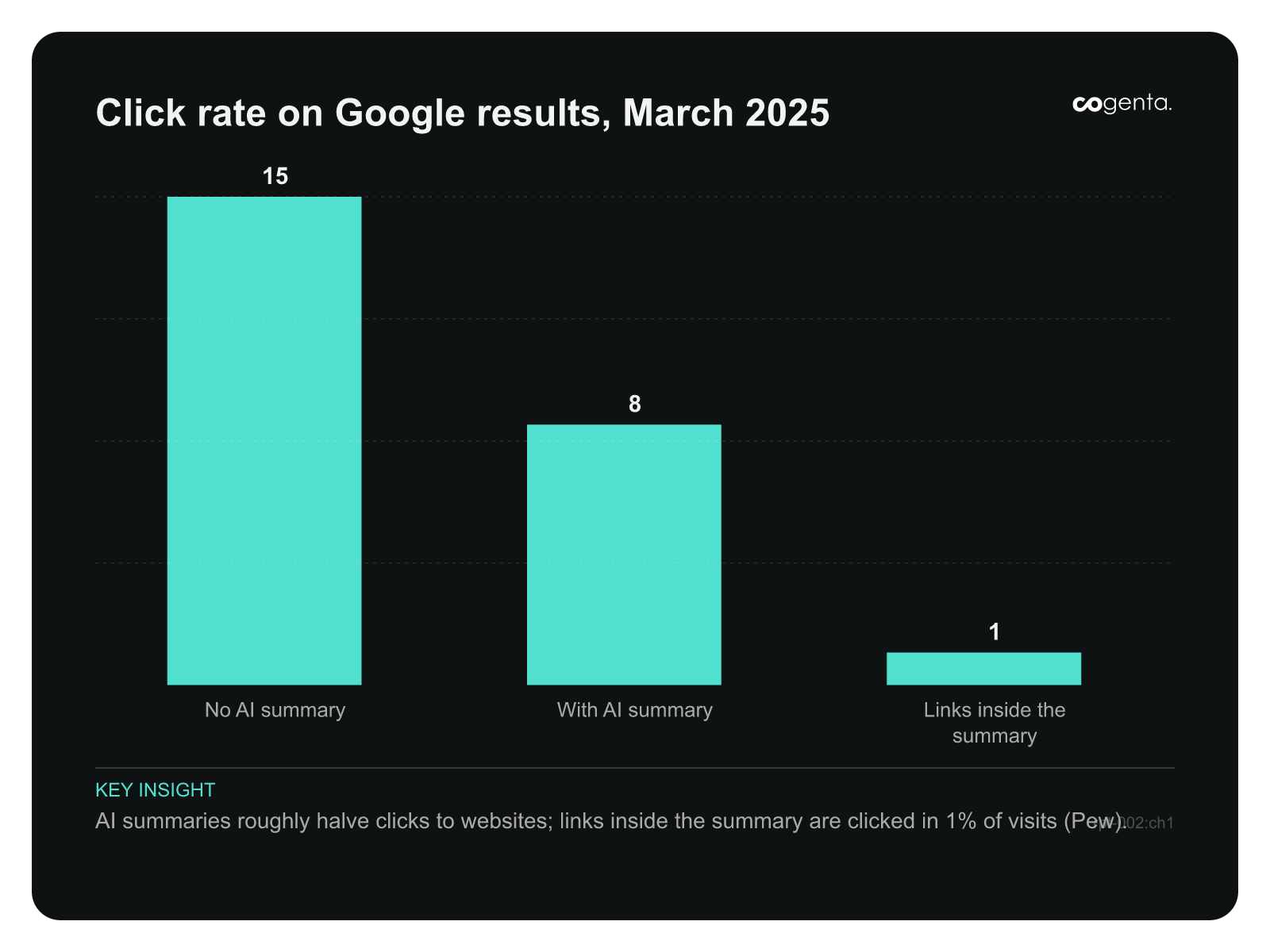
And when AI answers appear, they keep attention rather than sending it to you. Pew Research metered the real browsing behavior of 900 US adults and found that when a Google search produced an AI summary, users clicked a traditional result in 8% of visits, roughly half the 15% rate without a summary.
Links inside the AI summary itself were clicked in 1% of visits5. Question-formed searches, the kind buyers ask, triggered AI summaries 60% of the time5.
Put both halves together and the shape of the channel is clear: more buyer questions are being answered by machines, and the answers rarely produce a visit.
The unit of value is shifting from the click to the mention. Your business can win or lose a shortlist inside an answer you will never see, on a question you will never log.
That is the visibility problem in one sentence, and it is why measurement, not tactics, is the rational first move.
What decides whether you appear
The mechanics have one peer-reviewed anchor. The GEO study (KDD 2024) ran controlled experiments on how content changes affect a source's presence in generative answers and found targeted changes raised visibility by up to 40%, with a detail that should interest every small firm: gains concentrated in lower-ranked sites, while the top-ranked site lost roughly 30% of its visibility.
Generative answers flatten the winner-take-all curve of classic search8.
What worked was substance: adding quotable statistics, citations, and clear attributions outperformed keyword stuffing, which sometimes backfired8.
Generative engine optimization, or GEO, is the practice of structuring content so AI systems can find, quote, and attribute it; on current evidence it rewards exactly what credible publishing already required.
A large 2025 measurement study, not yet peer-reviewed, adds the sourcing bias: AI search engines drew roughly 65% of their citations from earned media, third-party sources they treat as authoritative, against Google's more balanced mix7.
If that holds, your biggest visibility lever is not on your own website: it is being written about.
The same evidence-first reading we applied to AI layoffs applies here: the loudest claims in this market come from parties selling the fix, and the tactic lists they sell go far beyond what any study has verified.
We cover what the evidence actually ranks, including what we are testing on our own site, in a follow-up piece.
Measure before you spend: the 15-question audit
First, know what you are measuring, because AI answers are unstable by design. Profound, an AI-visibility tracking vendor reporting its own telemetry, found 40 to 60% of the domains cited in AI answers to identical questions change within a month10.
An independent practitioner experiment reached the matching conclusion from the other direction: rankings inside AI recommendation lists are near-random across repeated runs, but presence across many runs is stable, with one brand appearing in 69 of 71 answers to the same question9.
Academic measurement work agrees and recommends treating visibility as a distribution over runs, not a single score11. A screenshot of one answer proves nothing in either direction.
The audit that survives that instability is a fixed panel, and you can run it without buying anything:
- Write 15 questions your buyers actually ask, in their words, not yours: "who can fix our CRM chaos", "best CRM consultant for a small business in Belgium", "why do leads go cold between marketing and sales". Keep them fixed month to month.
- Ask them across the major assistants (ChatGPT, Gemini, Copilot, Claude, Perplexity), fresh sessions, no account personalization.
- Ask in English and in French. Belgian buyers use both, and research on multilingual consistency shows LLM answers do not reliably match across languages, even high-resource ones12. An English-only check measures half your market.
- Count mentions and citations of your business across all runs. The rate is your score; the individual answers are noise.
- Repeat monthly. Trend beats snapshot.
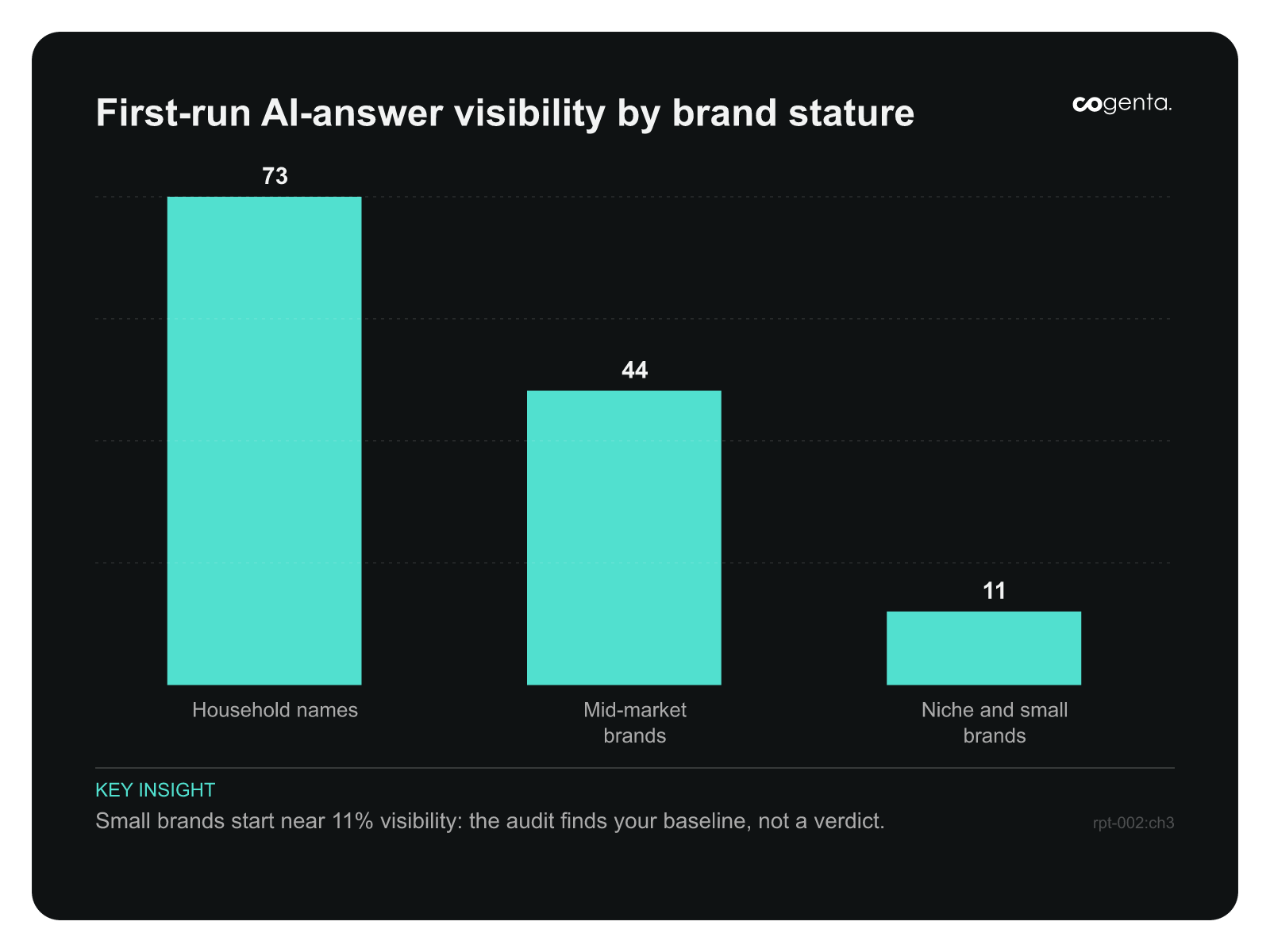
Calibrate expectations before the first run. The largest brand-visibility measurement to date, a 2026 study built on 100,000-plus tracked prompt responses, found household names appearing in 73% of relevant AI answers, established mid-market brands in 44%, and niche or small brands in 11%13.
A small consultancy scoring in the low single digits has not failed the audit; it has found its baseline. The point of measuring is that the GEO evidence above says this curve is flatter than classic search ever was for small players8.
We run this panel on our own business monthly and publish the method as we refine it. If the checker tools you see advertised do this better at scale, fine; the point is that the honest version costs discipline, not subscriptions.
Where this leaves a Belgian SMB
The inputs that determine whether an assistant can describe you accurately are the unglamorous ones: a substantive site, dated and attributable facts, structure a machine can parse, and some third-party footprint.
On those inputs, the official statistics say most European SMBs are underequipped: 74% of all EU businesses reached basic digital intensity in 2024, against an EU target of more than 90% of SMEs by 2030, and the size gradient on digital investment remains steep14.
The OECD reaches the same conclusion for AI adoption specifically: SMEs trail larger firms across every G7 economy15.
Belgium enters this shift strong on infrastructure and enterprise adoption but with SME digital uptake flagged as the area to strengthen16, the same paradox we documented in High Earnings, Low Tech.
Read cynically, that is a gap. Read as an operator, it is a window: the average competitor is not equipped to show up in AI answers either, and the inputs that get you mentioned are the ones that already made your site credible to humans.
AI without the hype, applied to your own visibility: measure first, fix the substance the measurement exposes, and skip the tactic lists until someone independent verifies them.
If you want a second pair of eyes on what your audit turns up, or on the revenue system behind it, book a free discovery call. One conversation, no pitch.
FAQ
Do buyers really use ChatGPT to find services or vendors?
Yes, and increasingly: a quarter of B2B buyers now use generative AI more than search for vendor research (vendor survey4), a third of EU individuals used generative AI in 20251, and half of US adults use it weekly2. But adoption is uneven: outside the US, only 14% of buyers use it for vendor discovery4, and consumers use AI to narrow choices rather than to decide3.
How do I get my business to show up in AI searches?
The only controlled evidence points to substance: quotable statistics, cited sources, and clear attributions on your site raised visibility in generative answers by up to 40% in experiments8, and third-party coverage matters more than your own pages in what AI engines cite7. No tactic beyond that has independently verified effect sizes yet.
How do I get ChatGPT to recommend my business?
You cannot force it, and anyone promising a guaranteed placement is selling past the evidence.
Recommendation lists are near-random run to run9; what is stable is presence rate across many runs, which follows from the substance and third-party footprint above8,7. Measure your rate monthly and improve the inputs.
How can I check what AI assistants say about my business?
Run the 15-question audit above: fixed buyer questions, the major assistants, English and French, counted across runs, repeated monthly. It requires no tooling.
One answer proves nothing; the mention rate across runs is the metric9,11.
Is AI search replacing Google for finding vendors?
Not yet, and not soon: Google holds 88.62% of European search (vendor measurement data6), and AI summaries mostly reduce clicking rather than redirect it5. The honest framing is a second, growing discovery surface that runs on mentions instead of visits, next to a dominant one that still runs on clicks.
Sources
- Eurostat, "Use of artificial intelligence by individuals", March 2026 (2025 survey data).
- Edison Research at SSRS, "Half of Americans Using AI Chat on Weekly Basis", 2 March 2026.
- Gartner, "Consumers Want AI Shopping Help, But Not AI Purchase Decisions", 27 May 2026.
- Responsive, "GenAI Overtakes Search for a Quarter of B2B Buyers", 15 October 2025 (vendor research, labeled).
- Pew Research Center, "Google users are less likely to click on links when an AI summary appears", 22 July 2025.
- StatCounter Global Stats, "Search Engine Market Share Europe", June 2026 (vendor measurement data).
- arXiv preprint 2509.08919, "Generative Engine Optimization: How to Dominate AI Search", September 2025 (not yet peer-reviewed).
- Aggarwal et al., "GEO: Generative Engine Optimization", KDD 2024.
- SparkToro (Rand Fishkin), "AIs are highly inconsistent when recommending brands or products", 27 January 2026 (practitioner research).
- Profound, "AI Search Volatility", fetched July 2026 (vendor telemetry, labeled).
- arXiv preprint 2604.07585, "Measuring Visibility in AI Search", April 2026 (not yet peer-reviewed).
- arXiv 2505.21999 / IJCNLP 2025, "Found in Translation: Measuring Multilingual LLM Consistency", 2025.
- arXiv preprint 2606.20065, "Measuring Brand Visibility Across AI Search Engines", June 2026 (not yet peer-reviewed; commercial tracker data).
- Eurostat, "Digitalisation in Europe, 2025 edition".
- OECD, "AI adoption by small and medium-sized enterprises", December 2025.
- European Commission, "Belgium 2025 Digital Decade Country Report".
Read more

AI layoffs: what the data actually shows
AI led stated reasons for US job cuts this spring, yet total layoffs fell by half. Four data checks show what AI layoffs mean for your business.
Jul 7
How artificial intelligence is transforming CRM
From data clean-up to predictive lead scoring: how AI-powered CRM helps SMEs save hours, close more deals, and personalize at scale without a data team.
Mar 4
Why CRM projects fail small businesses
The famous CRM failure rates trace to marketing, not measurement. Here is what the evidence actually says about why CRM fails and what makes it stick.
Aug 9