Why CRM projects fail small businesses
Diego Mols

What you can expect in this article
- Where the famous 50-70% CRM failure rates actually come from, traced source by source
- What current measurements really show: integration gaps, shelfware, and dissatisfied loyalty
- The three failure causes with evidence behind them, and the order to fix them in
- Why the data-decay statistic everyone quotes is dead, and what to measure instead
- An honest spreadsheet-versus-CRM threshold for small teams
- The Belgian and EU adoption numbers that show the real divide is firm size
Ask why CRM projects fail and the internet answers with a number: 50%, 63%, 70%. We traced those numbers to their sources, and the honest finding is that no widely quoted CRM failure rate has a reachable, current, methodological floor under it2,3.
CRM projects do fail, just not the way the statistics claim. The documented causes are organizational: nobody agreed what the process is, the system is used to watch people instead of helping them, and the three parties in the room want different things1,10,12.
This piece walks through the evidence on why CRM fails a small business, what the real numbers say in 2026, and what actually makes a CRM stick.
The famous failure rates are marketing, not measurement
The lineage is easy to reconstruct, because it keeps getting reprinted.
A 69.3% failure rate from a sales magazine survey in 2002. 56% from the Economist Intelligence Unit in 2007. 47% attributed to Forrester in 2009. 63% from a Merkle study in 2013 whose original is no longer reachable anywhere3.
Harvard Business Review aggregated 12 analyst reports in 2018 and got a range of 18% to 69%1,2. A range that wide is not a measurement. It is proof that nobody agreed what failure means.
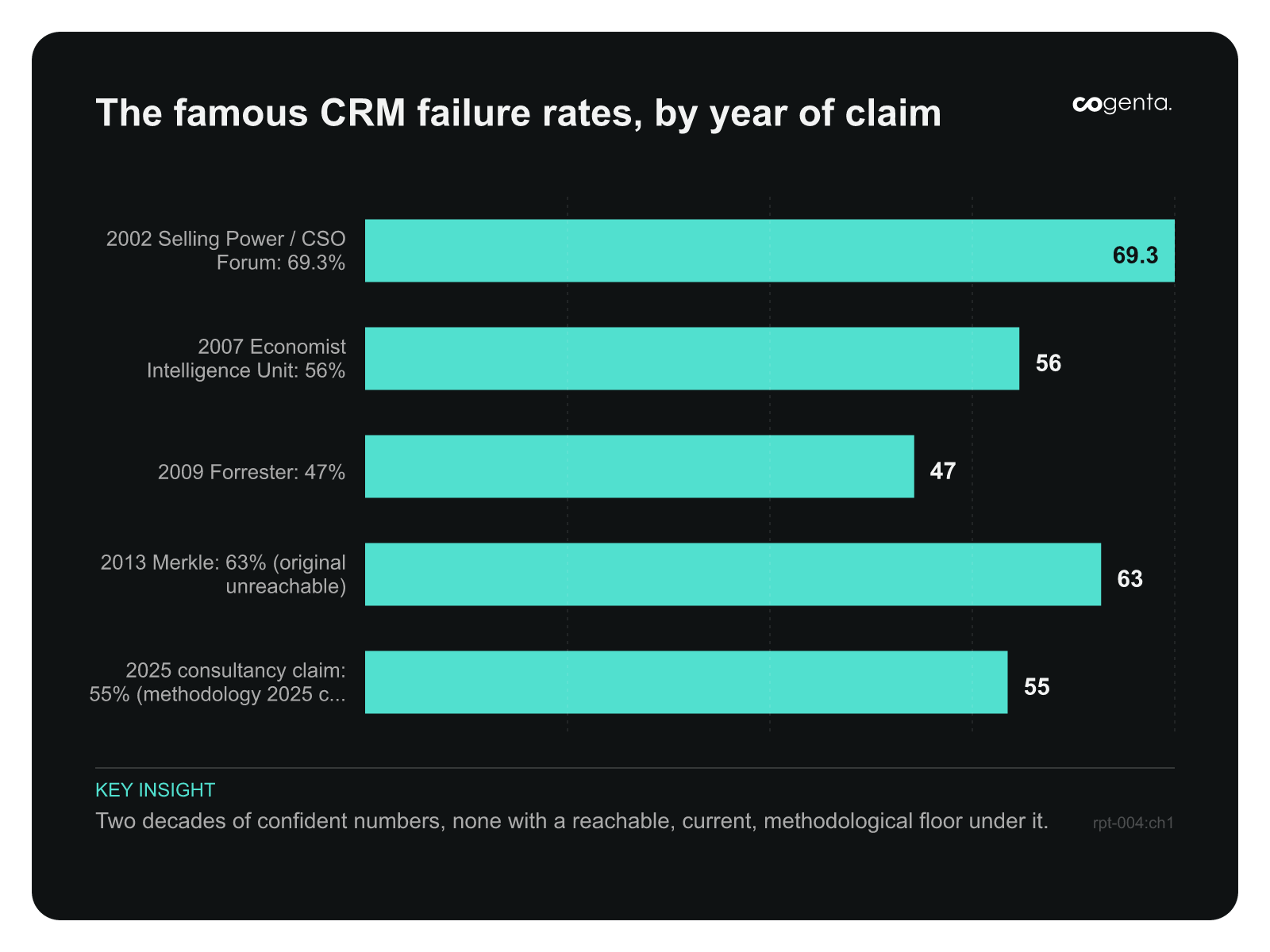
The strongest rebuttal comes from inside the house. Ed Thompson, the Gartner analyst whose firm gets quoted for the 50-to-70% meme, said on record back in 2009 that in the underlying surveys absolute failure was around 5%, and 65 to 70% of adopters reported some form of success4.
The famous rates, in his telling, come from compressing multi-box survey answers into a binary called failure4.
One more detail settles the audit. A roughly 50% failure figure circulated about mainframe IT projects in the 1980s, before CRM existed3. The number predates the thing it now describes.
Even peer-reviewed papers repeat the meme: a 2018 systematic review opens with "almost about 70% of all CRM implementation projects fail", with no primary source attached5.
So here is the sentence worth keeping: anyone quoting a CRM failure rate without a definition, a year, and a sample is quoting folklore.
What failure looks like now
Retire the headline rate and the real, current failure forms remain. They are more useful than any percentage.
The integration form. In a 2025 Bain survey of senior commercial executives across 18 industries, more than 80% claim structured, repeatable sales plays, yet 70% say those plays are not effectively integrated into their CRM and revenue technology6.
The strategy exists, the system exists, and they do not meet: revenue leaks in the gap between them.
The satisfaction form. Forrester's 2023 survey data shows CRM adoption at 62 to 70% across service, marketing, and field functions, with satisfaction low overall, and organizations staying loyal to vendors they are dissatisfied with7.
Dissatisfied-but-staying is a failure form no failure rate can see.
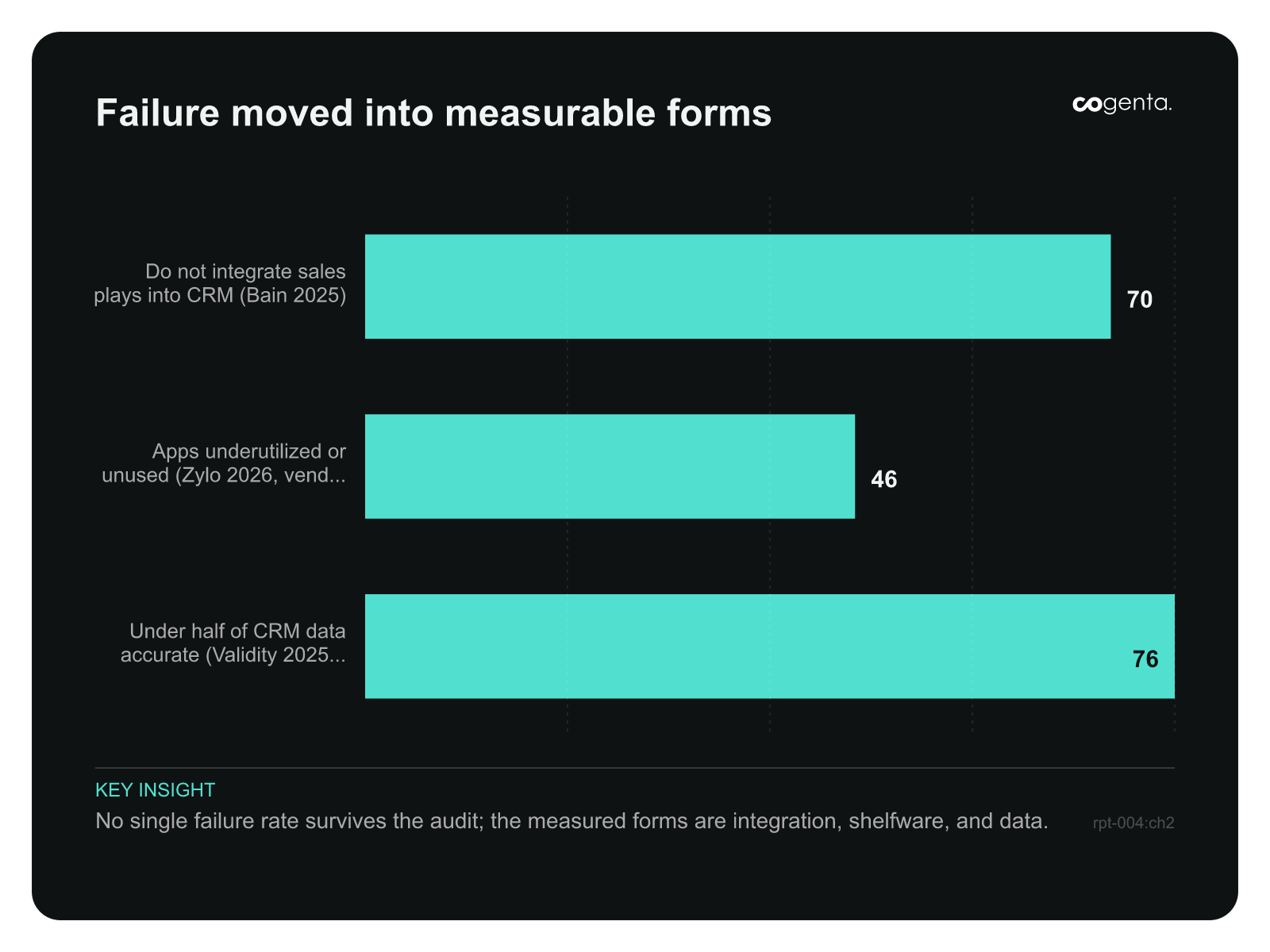
The shelfware form. Vendor data, labeled as such: 46% of software applications go underutilized or unused, an average of $19.8 million per year in unused licenses in an enterprise-skewed portfolio9.
The small-business version of that line item is smaller and hurts more: a licence paid monthly for a system nobody opens.
The data form. In a 2025 survey by Validity, a data-quality vendor measuring the problem it sells the fix for, 76% of organizations said less than half of their CRM data is accurate and complete8.
This is why so many companies searching "why smbs abandon crm" already know the answer. The system stopped describing reality, and everyone quietly went back to the spreadsheet.
The three causes with evidence behind them
Nobody agreed what the process is
SME-specific research has been blunt about the order of operations since at least 2019: successful implementations redesign the process and involve the staff before choosing software11.
The critical-success-factor literature says the same thing in reverse: absent objectives, absent management involvement, and absent change management are the repeating failure pattern5,10.
A CRM is a container for definitions. If "lead", "opportunity", and "closed" mean different things to different people, the software faithfully stores the confusion.
The system watches instead of helps
The Harvard Business Review thesis from 2018 has aged well: CRM projects miss the mark on revenue because they are used for inspection rather than for improving the sales process1.
A tool bought as a management camera gets treated like one by the people it films. Adoption follows accordingly, and adoption is where the return lives13.
Three actors, three agendas
The most current academic finding reframes the whole question. A 2026 study of Italian SMEs concludes that CRM adoption unfolds between three actors: the user firm, the software vendor, and the consultant, and that failures are relational, not primarily technical12.
The vendor wants renewal. The consultant wants billable configuration. You want a working revenue motion. Nothing dishonest has to happen for those three agendas to quietly diverge.
Which is why the practical check before any signature is alignment: who defines the process, who owns the data model, and who is accountable for adoption ninety days in12.
The data problem is real even though the decay statistic is not
You have probably read that CRM data decays at 22.5% per year. That number traces through a live vendor marketing page to an email-marketing estimate from around 2013, whose original source is no longer reachable14.
We checked: the decay statistic has itself decayed.
The underlying problem is real, though currently measured mostly by interested parties: in the same labeled vendor survey, respondents reported losing revenue to bad data, losing an average of 16 deals per quarter, and spending 13 hours per week per worker on data issues8.
The practical move for a small business costs one afternoon: pull 50 contact records, count what is wrong, and multiply. Your own decay rate beats any statistic we could not verify.
And bad data compounds the other causes: a system whose records are half wrong gets distrusted, then bypassed, then abandoned8,7.
When a spreadsheet is honestly enough
A vendor-neutral answer to "do I really need a CRM" has to include: sometimes, not yet.
Most small European enterprises run customer relationships without CRM software: 24.69% of small EU enterprises used it in the 2025 survey year, which means three in four do not15. That majority is not uniformly failing.
But the spreadsheet has a measured ceiling, and the measurement is old enough to say so plainly: the spreadsheet-error research programme ran from 1997 to 2008, found errors in 91% of audited organizational spreadsheets, and put cell error rates at 1 to 5%, matching general human error rates for complex work; we found nothing comparable published since17.
At any moderate size, a 1-to-5% cell error rate almost guarantees a wrong bottom line somewhere17. Error is a property of the medium, not a discipline problem, and the medium has not changed since the measurements were made.
Our threshold, synthesized from the evidence and labeled as ours: the spreadsheet stops being enough when more than one person edits the same customer record, when the sheet feeds decisions with money on them, or when follow-up depends on memory instead of the system.
Below those lines, keep the sheet and run a weekly hygiene pass. We wrote about the spreadsheet-versus-CRM decision before; the threshold logic still rests on that same error evidence.
Above those lines, the question is not which tool to buy. It is whether you are ready to define the process the tool will hold, because that is where failure actually starts11,12.
What makes it stick
The success literature is the failure literature inverted, and it is consistent across decades.
The repeating factors: objectives defined before selection, management involvement that is real rather than ceremonial, and change management treated as the project rather than the appendix5,10.
For small firms specifically: process redesign and staff involvement before software choice, and selection criteria weighted toward usability and process fit over feature depth11.
The economic mechanism is adoption. KPMG's practice work put it plainly in 2021: user adoption drives CRM return on investment, and adoption follows visible user value, not mandates13.
What we will not give you is an ROI figure. The circulating claims ($8.71 per dollar, 211%) are relays of relays with no reachable source, and quoting them would repeat the exact pattern this article audits2.
The Belgian picture
The official statistics draw a more useful map than the folklore, and for once Belgium looks good on it.
Two Belgian enterprises in five use CRM software in Statbel's 2025 survey, rising to 77.1% above 250 employees16. Across the EU, small enterprises sit at 24.69% against 65.43% for large ones15.
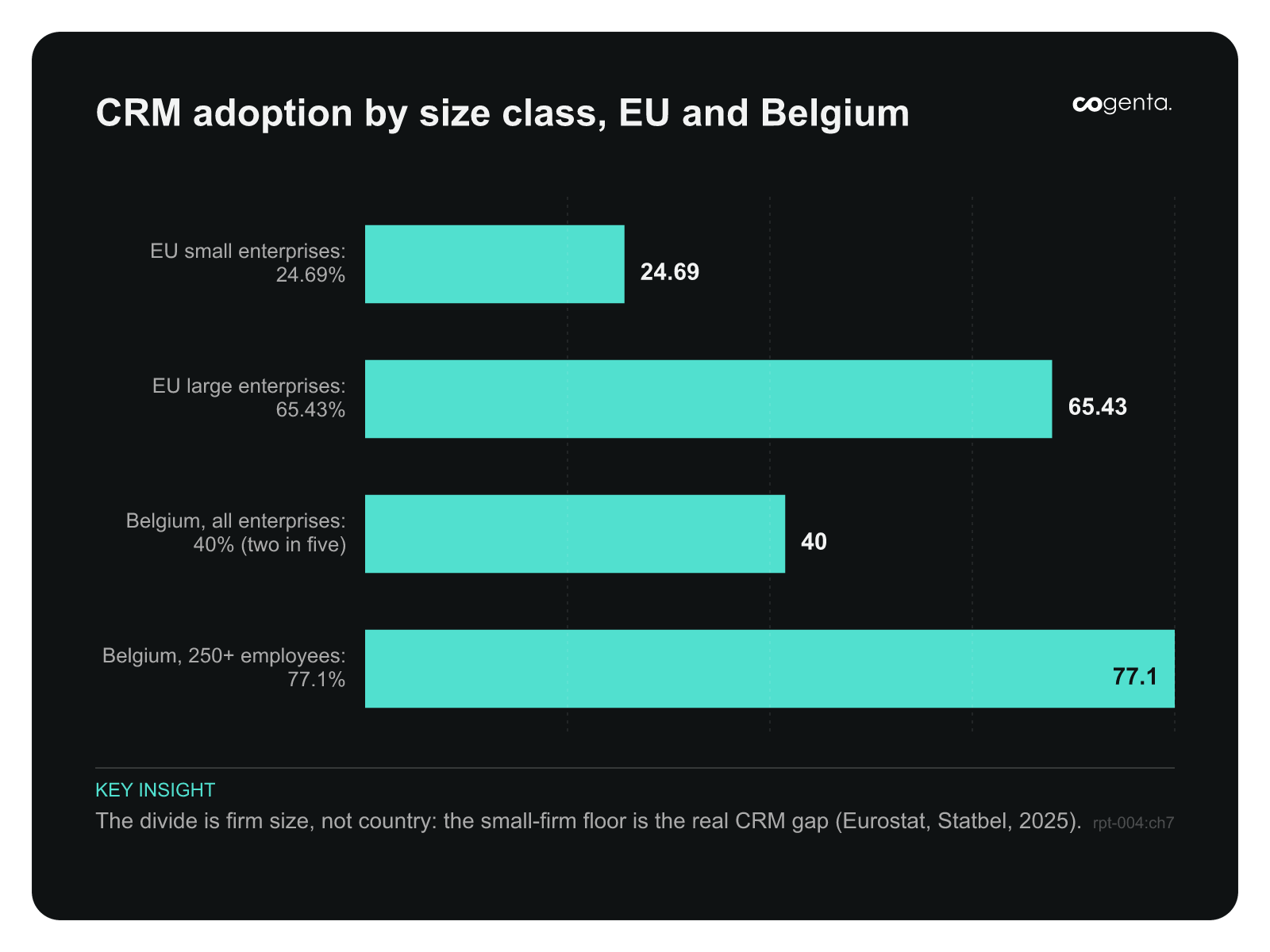
The real divide runs between size classes rather than countries, and it widens as systems connect: 22.8% of Belgian enterprises combine AI, cloud, and advanced analytics, against 70% of enterprises above 250 employees16.
That integrated-stack gap is the same leak we keep writing about: the customer experiences one relationship, and every unconnected tool is a place where it quietly breaks. The CRM challenges we mapped for SMBs all live in that gap.
So the Belgian small business question is rarely whether the country is behind. The sharper question: which side of your own size class do you want to be on.
FAQ
Why do CRM projects fail?
For organizational reasons the evidence documents consistently: no agreed process definitions, systems used for inspection instead of helping the work, and misalignment between the firm, the vendor, and the consultant1,10,12.
What is the real CRM failure rate?
Nobody has a current, defined, citable one. The famous 50-to-70% figures trace to 2001-2013 marketing and survey compressions, and Gartner's own analyst put absolute failure near 5% in the underlying data, on record in 20092,3,4.
Do I really need a CRM, or is a spreadsheet enough?
A disciplined spreadsheet holds until more than one person edits the same records, money decisions depend on the sheet, or follow-up depends on memory. The audited error rates (measured 1997-2008, unmeasured since) put a hard ceiling on scaling it17.
How do I get my team to actually use the CRM?
Make adoption the project: define the process with the team first, pick for usability and process fit, and make the system visibly useful to the person typing, not just to the person inspecting11,13.
How many small businesses actually use a CRM?
In the EU, 24.69% of small enterprises used CRM applications in 2025; in Belgium, roughly two enterprises in five across all sizes15,16.
Before you replace anything
If your CRM is failing, the evidence says the cheapest fix is rarely new software: it is definitions, process, and an adoption owner.
If you want a second pair of eyes on which of the three causes is eating your pipeline, book a free discovery call at cogenta.io/contact. We will tell you honestly if the fix is a process afternoon rather than a project.
Sources
- Harvard Business Review, "Why CRM Projects Fail and How to Make Them More Successful" (Edinger, December 2018).
- Johnny Grow, "CRM Failure Rates, Causes and Lessons" (consultancy page, 2023-2025; cited as an exhibit of the circulating numbers).
- EB Software, "50% CRM Failure Rate? Really?" (c.2019; cited as the lineage exhibit with years and outlets).
- CustomerThink, "The Reports of CRM Failure Are Highly Exaggerated" (interview with Gartner analyst Ed Thompson, c.2009).
- Future Computing and Informatics Journal, "A systematic review of CRM critical success factors" (Farhan et al., December 2018).
- Bain & Company, "70% of companies struggle to integrate their sales plays into CRM and revenue technologies" (April 2025).
- Forrester, "Forrester Data Shows High CRM Adoption But Low Satisfaction" (2023).
- Validity via PRNewswire, "The State of CRM Data Management in 2025" (July 2025; vendor survey, labeled).
- Zylo, unused-software analysis citing the 2026 SaaS Management Index (2026; vendor data, labeled).
- Proceedings of the International Conference on Business Excellence, "Organizational Barriers in CRM Implementation in Sales Companies" (Gologan et al., 2025).
- Administrative Sciences, "The Best Practice of CRM Implementation for SMEs" (Pohludka and Stverkova, 2019).
- Piccola Impresa / Small Business, "CRM adoption in SMEs: what's wrong?" (Cinti, Sabatini, Lillini, Temperini, 2026).
- KPMG, "CRM Technology: Unlock the value of CRM through user adoption" (July 2021).
- HubSpot, "Database Decay Simulation" (live 2026, underlying estimate c.2013; vendor page, cited as the decay-meme exhibit).
- Eurostat Statistics Explained, "Digital economy and society statistics, enterprises" (2025 survey data).
- Statbel, "ICT and e-commerce in enterprises" (2025 survey).
- Panko, "Spreadsheet Errors: What We Know. What We Think We Can Do." (2008, research lineage 1997-2008).
Read more

Top 5 CRM selection mistakes your small businesses can't afford
Master CRM selection, avoid pitfalls & challenges. Get our expert guide to finding the perfect CRM for your needs.
May 12
5 critical CRM challenges facing SMBs in 2025
Master the 5 biggest CRM hurdles: selection, implementation, adoption, integration, and security - practical solutions for SMBs to boost efficiency and growth.
May 7
CRM vs. Spreadsheet: Top 3 reasons it's time to upgrade
Ditch spreadsheets, boost customer relationships: Learn why SMEs need a CRM for efficient scaling and growth.
Mar 4